What you need to know
- Maxinsights says its new funding supports a robotics data pipeline spanning capture and quality checks.
- Specify which signals are measured, estimated or missing before accepting a dataset.
- Treat MaxGlove development and planned robot evaluation separately from demonstrated deployment outcomes.
Funding the path from recording to instruction
Maxinsights announced a $30 million seed round led by Peak XV on October 22. The company collects first-person recordings of human activity for robotics training. It also introduced MaxLoop, software it says checks incoming footage and returns feedback to the people recording it. MaxGlove, being developed with Genesis AI, is intended to add measurements of touch and force.
For a robotics team, the investment points to a purchasing decision that deserves more detail than a video-hour total. A buyer needs to know what arrives, which conditions it represents and how it fits the training system. Financing can support a collection operation; acceptance still belongs to the team building the robot.
Define what the recording preserves
Maxinsights’ research framing distinguishes the breadth of experience collected from the physical information retained within each recording. It argues that coverage of different environments and richer descriptions of interaction serve different purposes. Its website describes automated checks alongside expert review and notes that contact and force outputs require dedicated sensing.
An acceptance specification could make that distinction concrete. Ask which parts of an interaction are directly measured, which are estimated and which are absent. Require a description of how uncertain labels are handled. A clip can look clear to a person while leaving the training team unable to tell whether a useful signal was recorded or inferred.
Connect collection checks to the intended task
The company describes MaxLoop as a way to examine recordings as they arrive rather than leave correction until a later review. That is a process claim, not a demonstrated improvement in a customer’s robot. Its value should be assessed against the conditions that make a delivered sample usable for the intended training run.
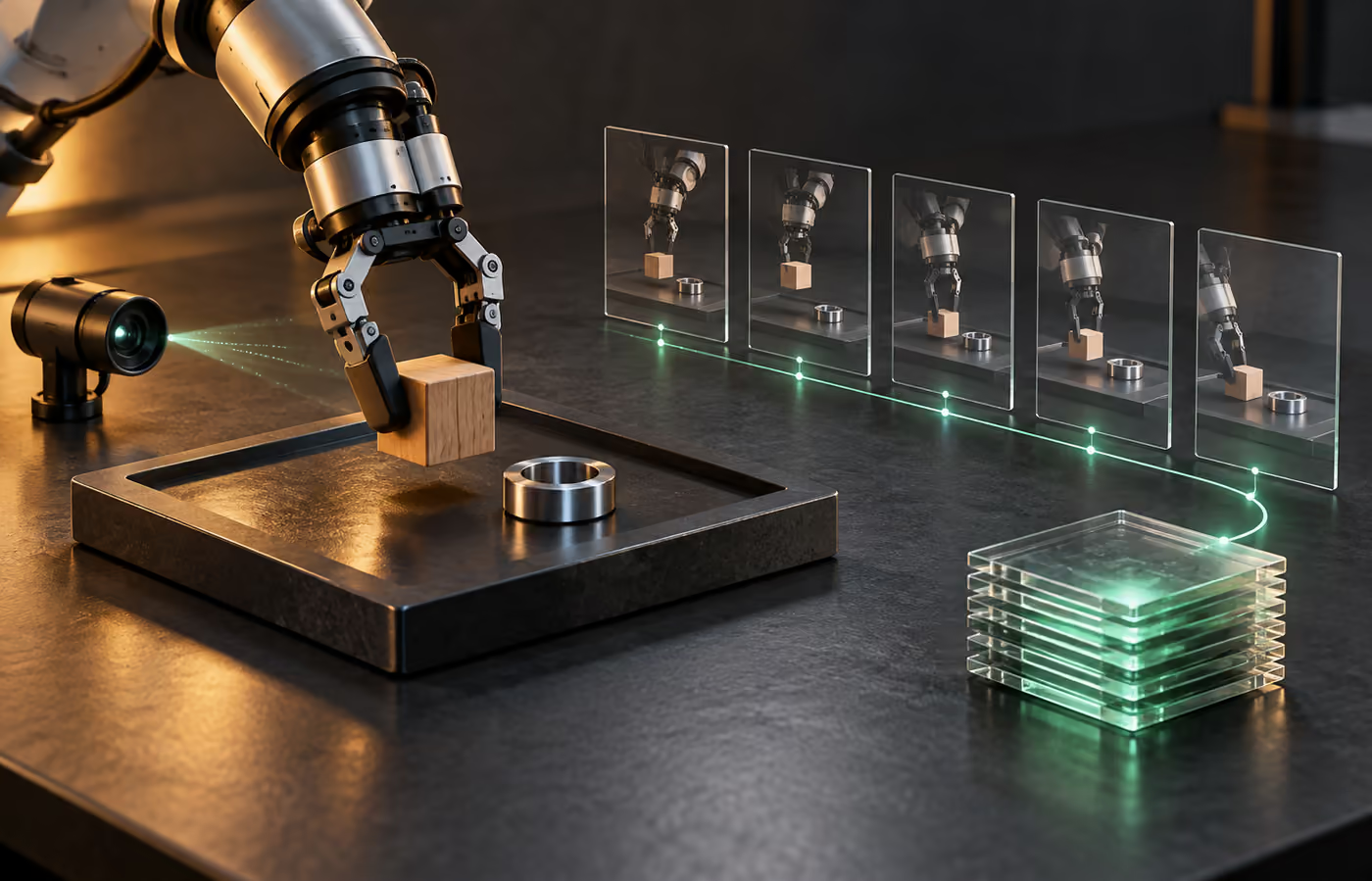
A practical review could follow a small batch from capture through correction and final acceptance. Record why material was rejected and whether the replacement resolves that problem. Include difficult examples deliberately, with agreed handling for uncertain cases. Keep the acceptance rules stable during the review so that a changing definition of usable data does not obscure the result.
Give force data its own acceptance decision
Maxinsights says MaxGlove is designed to record grip force, object weight and changes in contact during an activity. The device remains in development. The company’s broader website also labels evaluation on robots in their target environments as a planned next step, rather than an established service outcome.
A buyer considering combined video and sensor material could request an example showing how the streams line up and how missing readings are identified. Decide in advance whether a partially recorded interaction is useful. Compare the resulting dataset with the exact capability the team wants to improve, using a separate evaluation rather than collection volume as the success measure.
The commercial opportunity is to make physical experience dependable enough to buy repeatedly. That requires a delivery agreement a customer can inspect: defined inputs, visible uncertainty, a correction route and an acceptance decision tied to the machine’s intended job.