What you need to know
- TPU availability on OCI is planned for 2027, with a multi-year ramp.
- Accelerator selection and cloud selection become more separate decisions.
- Data location and the complete application path belong in a compute comparison.
A new route to Google’s accelerators
Oracle and Google announced on October 27 that Google’s Tensor Processing Units will become available through Oracle Cloud Infrastructure. The companies describe OCI as the first hyperscale cloud outside Google to offer the accelerators. Availability is planned for calendar 2027, followed by a ramp over several years.
Oracle says it will supply the power, cooling and data-center networking for the deployment. The announcement covers training and inference workloads, including large models and long-context applications. This is a planned expansion of the service portfolio; it does not establish capacity that customers can reserve today.
The commercial significance is a separation between two choices that can otherwise arrive together: whose accelerator runs a model and whose cloud hosts the surrounding application. Buying a particular chip architecture would no longer necessarily require placing that workload in the chip developer’s own hyperscale cloud.
The location of the data changes the calculation
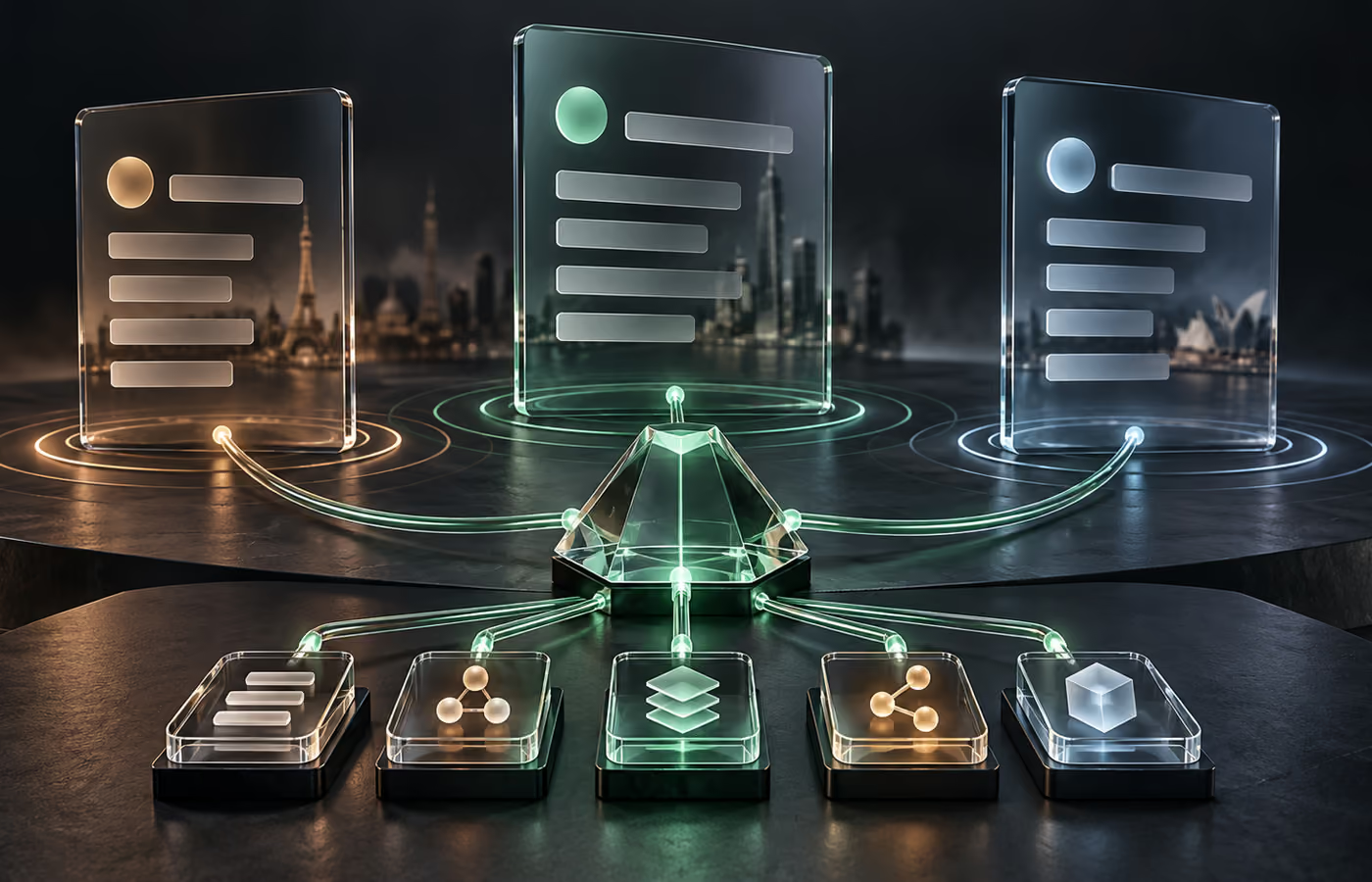
The joint technical announcement emphasizes proximity to enterprise records. It says TPUs within OCI will let customers fine-tune and serve models near existing Oracle data, reducing the need for transfers between clouds. Oracle Acceleron would connect the TPU capacity to OCI databases and storage.
That matters because the accelerator is one part of an application’s route through information. A service might retrieve customer records, assemble context, run a model and write a result back to a database. Moving the model alone can add another boundary that the application must cross on each request.
Our analysis is that compute comparisons should follow that complete route. A team with records already in OCI would have a different placement decision from a team whose records sit elsewhere. The new hardware option changes the choices available at one location; it does not remove the relevance of data movement, permissions or response time.
The product includes the machinery around the processor
Google describes its TPU systems as combining silicon with optical networking, liquid cooling, power delivery and compiler software. Its explanation distinguishes productive cluster time during training from latency and cost per token during inference. These measures describe different kinds of work, even when the underlying hardware comes from the same family.
For the customer, this makes service integration consequential. A fast processor cannot complete a request while it waits for a database response. Likewise, a training cluster’s nominal capacity says little about a run interrupted by unavailable storage or a network fault. The useful comparison is the completed workload under its actual operating conditions.
The next milestone is a usable service
The announcements leave practical purchasing questions for the rollout: which regions and configurations will be offered, how much capacity will be available and what the service terms will cover. A procurement decision will need those details alongside a workload’s data location and software requirements.
The partnership therefore expands the possible infrastructure map before it changes an enterprise deployment. Its value will become clearer as Oracle turns the announced hardware relationship into a service that customers can provision, operate and support within their existing systems.