What you need to know
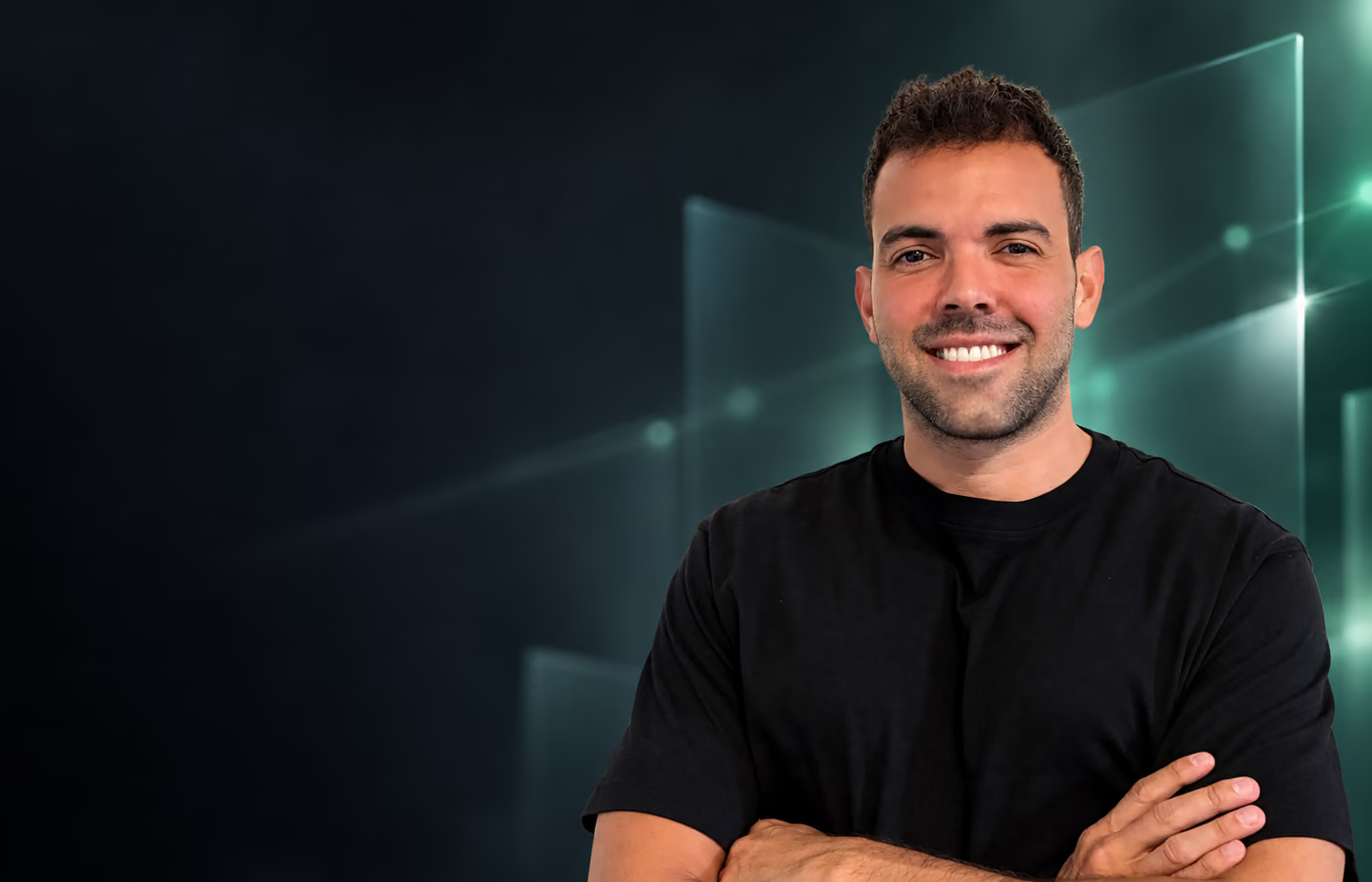
- Orel Emil Ohayon leads igeo.ai as founder and CEO.
- The company connects AI brand visibility with proposed content and marketing actions.
- Its product thesis centers on useful execution, with people reviewing work before publishing.
A founder focused on the moment a buyer asks
Orel Emil Ohayon is building igeo.ai around a question that reaches beyond a search ranking: what happens when a potential customer asks an AI assistant which business to choose? The answer may include a comparison, a judgment about suitability, or a shortlist that begins shaping the decision before a company receives a website visit.
For Ohayon, that creates an opportunity to build a company around the way brands are understood. As founder and CEO, he is pursuing a connection between what an AI system says, the evidence available about a business, and the work a marketing team can do next. His proposition brings the problem of discovery closer to the question of commercial choice.
A route through automation, marketing and software
His earlier career crossed several parts of the software business. In 2010, he founded Power, a wedding RSVP and seating-management venture that was later sold. He subsequently acquired Polaris Digital Marketing, worked with HiBob in its early years, led research and development at Studio Designer in Los Angeles, and ran PWM, an enterprise software and cloud-systems business.
Those are different operating settings: a tightly defined customer process, digital acquisition, a growing software product, engineering leadership and enterprise delivery. Together, they provide context for the scope of his current venture. The company he now leads sits where marketing activity meets software systems, with measurement and execution expected to work together.
Outside software, Ohayon’s interests include tennis and DJing techno and house music. His background also includes co-ownership of Mondo 2000, a rooftop venue in Tel Aviv.
A company built between Nicosia and Tel Aviv
igeo.ai says it began in 2024. Its current organization places its headquarters in Nicosia and research and development in Tel Aviv, alongside a remote-first team. That gives Ohayon’s company a base in Cyprus and an engineering presence in Israel as it develops its AI search proposition.
The geography is part of the founder story, while the product faces a broader test. A company serving this category has to make its value understandable across markets, languages and buying contexts. A relevant recommendation for one audience may be unsuitable for another. Building internationally therefore involves more than translating an interface; it also requires understanding whose questions the product is helping a brand answer.
The distance between being mentioned and being chosen
A central distinction in Ohayon’s thinking is the difference between visibility and recommendation. A brand can appear in an answer without becoming the option a buyer seriously considers. It can be described accurately in one respect while an important use case or differentiator is missing.
Consider a business evaluating software for a particular industry. A list of familiar products is only the beginning. The useful answer explains which option fits the constraints and what supports that assessment. This makes the surrounding information consequential: clear product explanations, credible experience and evidence beyond the company’s own pages. Ohayon’s focus on recommendation places the buyer’s decision, rather than a mention alone, at the center of the opportunity.
Turning an observation into the next piece of work
igeo.ai describes a connected process for identifying gaps between how AI represents a business and how that business wants to be positioned. Its platform is designed to turn those gaps into priorities, prepare relevant content and support distribution across owned, social, community and third-party channels. The company’s current workflow includes review and approval before publishing.
The significance for Ohayon’s company is the link between diagnosis and action. A team may discover that its product is poorly explained, but the finding still needs an owner, an editorial decision and a finished piece of work. The product thesis is that these activities belong in a connected system. That is a description of the company’s approach, rather than a guarantee that any particular intervention will change an AI answer.
The human responsibility inside an agentic business
Ohayon also acknowledges a complication in adopting AI: introducing tools can initially create more work. People have to learn them, fit them into existing processes and manage the additional output. Faster preparation only becomes useful when someone can turn it into better execution and check the result.
That is a meaningful tension for a founder building around agents. The software can help prepare an action, but a business still needs judgment about its message, priorities and evidence. Human responsibility remains part of the operating model. For igeo.ai, the challenge is to make that responsibility workable as activity grows, so review helps the company make decisions instead of becoming another queue of unfinished drafts.
Explaining the category while building the company
His public agenda has included explaining this emerging discipline to other business builders. He was scheduled to lead a workshop on making generative engine optimization profitable at StartupCon Europe in Limassol in June 2026. The subject connects the technical language of AI search with the commercial questions a founder or marketing leader needs answered.
For Ohayon, category education and product development meet at that boundary. Before a customer can evaluate a new kind of software, the problem has to be intelligible. A founder must explain what the system observes, what an organization can influence and how progress could be assessed. The strongest version of that explanation leaves room for uncertainty while still giving a business a clear reason to act.
The next stage depends on useful execution
Ohayon’s ambition is to build a global AI company from Cyprus. That remains an aspiration, with the practical work of building the product and business ahead of it. The defining question is how effectively igeo.ai can connect its view of brand discovery to work that customers find useful.
His current venture brings a familiar entrepreneurial task into a changing interface: identify a business problem, make it measurable and build a way to address it. The distinctive element is where the problem appears. It can emerge inside an answer assembled before the brand ever meets the buyer. Ohayon is building igeo.ai around that earlier moment, and around what a company should do when it arrives.